Google recently released the first public beta of their Chrome browser for Mac. While it’s speedy as heck, it lacks many basic features such as bookmark management/organization. Another popular feature the Mac version lacks is extension support. That is, until now. I spent the weekend running the latest version of Chromium, Google Chrome’s nightly beta builds. And thankfully, has come up with a way to re-activate the Install button on Google Chrome’s Extension site; allowing Mac users to install extensions into the latest Chromium builds.

Google Chrome for Mac now features extension support Here’s a quick tutorial to get extensions running in Chromium: • You must install Chromium, the widely-released Chrome beta won’t work. You can grab Chromium from the. Scroll all the way to the bottom and download the latest version. • Next, drag this link to your bookmarks bar: • Now go to Google’s.
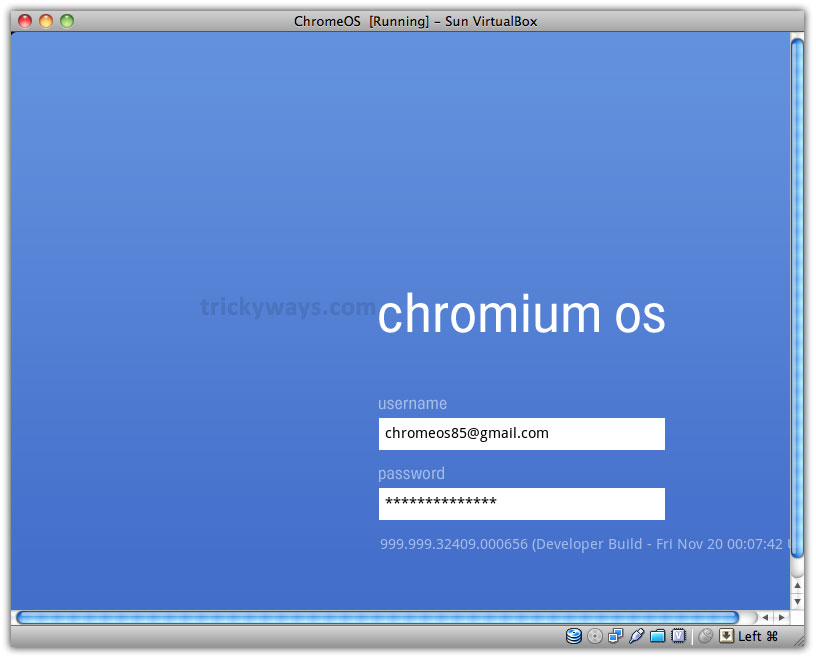
After a while Chrome OS interface will display and ask to get login through you Google mail account So, this was the process to run Chrome OS through VirtualBox on Mac OS X. This Chrome OS virtual image is created by gdgt hexxeh.
Click the bookmark you just created to activate the Install button on the extension pages. • Now choose some extensions to install and click the Install button on the extension’s page. You should now be able to install extensions into Chromium. Be aware that not all extensions will work. You’ll know if the extension is installing when you see an animation on the screen, and a dialog box appearing asking if you want to install the extension. Even then, some extensions I tried simply didn’t work.
I did get a few really nice ones to work, which includes: Feedly (my favorite RSS Reader), Share-a-holic, Chrowety (a Twitter client for Chrome), DChrome Facebook, Google Reader Notifier, and iGoogle tab remover. :max_bytes(150000):strip_icc()/ExcelCharts-5bd09965c9e77c0051a6d8d1.jpg "Add trendline to existing graph in excel 2016 for mac")
Chrome is the lightweight flagship browser that originated from an open source project by Google called Chromium and Chromium OS. It is now one of the more widely used browsers thanks to a vast ecosystem of extensions and add-ons, a robust Javascript engine, and a rapid-release development cycle that keeps it on the competitive end of the curve. Installation The self sustenance comes from 'channels'; Once you install the Chrome browser, Google will automatically roll out updates silently in the background and keep your software updated with the latest versions. Interface Chrome's overall UI has remained stable since version 1.0: a minimal two row window with tabs resting above the address bar (Omnibox), 3 browser controls (Back, Forward, Stop/Reload), a star-shaped toggle for bookmarking, and settings icon. Users coming from older browsers might have to get used to not having a dedicated File menu layout but we found ourselves getting quickly adjusted. As you install extensions, active icons will appear to the right of the address bar, but beyond that Google maintains strict restrictions on adding visible add-ons.
That means no toolbars or any undesired overlays, which at one point was a widespread standard practice. Despite the limited customiseable options, Chrome is minimalist for a reason, and that results in a clean browsing experience with maximum use of screen estate for websites.
It does not prevent saving of infected files (doing so could lead to irreversible data loss), it just detects them. Avast security for mac download. Meanwhile, Avast for Mac also execute on-demand scans on fixed disks, removable drives, and network shares and files can also be dragged and dropped onto the Avast Dock icon or into the area in the bottom-left of the application window for instant scanning. If your Mac computer is installed with Growl, you can even receive Avast’s alert messages are displayed on-screen whenever a Mac malware threat is detected. The File Shield prevents any infected attachments from causing harm to your system.