
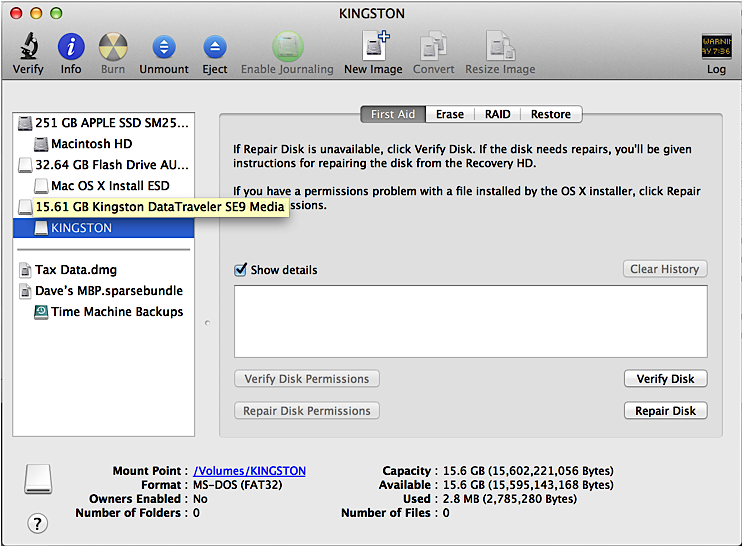
The main reason for formatting a USB drive as Fat32 on a Mac is that you want to be able to use the drive on a Windows PC, as well as a Mac — perhaps to transfer files between the two machines. You may also be preparing the drive for use as, say, a storage device for a media player or to record TV programmes on a TV with a USB port.
As I've said before, for me. At one point, I realized that there were plenty of files on my Mac that I didn't need any more, but too many to delete individually.
Second, assigning Everyone Read/Write permissions on the shared drive permits anyone to do anything on the drive, including erase it. This presents some security issues. Usb showing different files for mac and windows. First, providing a Windows user with an Admin account gives them free reign to do anything, including delete your account or erase the drive. Sharepoints set up as seen in the screen shot only work if you log into a Standard account on the Mac sharing the drive from another Mac on the local network.
In other cases, your Mac can be experiencing some major malfunctions: constant crashing, locked controls, slow boot times, missing files, etc. Often, the best option to fix these problems would be to reformat your computer and reinstall your OS, but since most of us don't plan on ever taking this drastic measure, we don't obtain a recovery disc or thumb drive. Thankfully, the geniuses over at Apple have made the process easy for us—no need for a disc; no need for a drive—all you need is a decent internet connection. With just a few clicks of some buttons and your Mac is gonna be running like it did the day you got it. Best of all, this will work with Lion,,,,.
Step 1: Back Up Your Files! Okay, so you may have a lot of files that you want to get rid of, but you definitely have some files you want to keep. In my case, I even have programs I want to keep so I don't have to re-download them after the process is over. Use a writable CD/DVD, a, or any of the multitude of cloud options to keep your important files backed up. You could also create a Time Machine backup, but I wouldn't do a full restore later—just pick and choose things you want back after a fresh install—otherwise it could run just as sluggishly or erratic as it did before. Step 2: Restart Your Computer Once you've double-, triple-, and quadruple-checked your backups, restart your computer. Step 3: Press CMD+R The second you see a grey screen, hold the CMD and R keys down for about 15 seconds, then let go and you'll be taken to OS X Utilities recovery.
PLEASE HELP!! Whenever I turn on my iMac, it would load up to the apple logo and shut down after a few seconds. This happened ever time i tried to turn it back on again.
I had a bit of hope but nothing ever changed so I decided to erase my disk and was immediately promoted me to restart my computer. When I did, it brought me a a symbol of a folder with a question mark which flashed forever. I held the power button to turn it off and hit it to turn it on again while pressing command and R keys at the same time, it brings me a sign of a spinning globe that loads forever. When I restart it and immediately insert its installation DVD while pressing key C, it brings me the apple logo and stays like that for ages. This is freaking me out.
I have read and tried so may solutions online but nothing has changed. Please help me with another way. In summery, my computer has no files and I won't install a new OS. So I'm having a slightly different issue. I've followed your steps, but every time I hit 'erase,' it brings up a notice saying: 'Disk Erase failed with the error: Couldn't unmount disk.'
I've attached a pic of the error. However, on the left one can clearly see the main '500.11 GB Toshiba MK5,' and below it, the 'Macintosh HD' option. This error pops up ONLY when I try to erase the Toshiba drive. But it allowed me to erase the Macintosh HD option.
Has my drive been erased nonetheless? Or do I still need to do something else? Is all hope lost? FYI: was running Mountain Lion.
My original install discs are probably lost for good.
By - guest writer. The latest trend with computers is not including a CD/DVD drive. This helps the computers to be small and lighter. Apple has started doing this when the Macbook Air arrived on the scene.