When you buy a new hard drive, your first impulse may be to connect it to your Mac and start copying files to the new drive. But with all that new storage space it might make sense to partition the hard drive. When you partition, you are dividing the hard drive’s storage space into sections. For example, you can partition a 1TB hard drive into two 500GB sections. Each section would appear on your Mac’s desktop like a single hard drive would. Partitioning can help organize your data.
Following the process outlined above will make your external drive compatible with your devices running on Mac OS. Do keep in mind that this would be an unnecessary step if you wish to use your external hard disk or USB flash drive interchangeably between Windows and Mac devices. Select 'Restore Files' to open the 'Restore a Backup' window. Choose to restore the most recent file version or a historical version of the file. Navigate to the file using the 'Seagate Backup' folder on the external drive. Select the file and then drag it to the location on your hard drive you wish it restored.
You can create a partition that stores just the documents you create, or dedicate a partition to storing your iTunes media. This tutorial goes through the steps of partitioning an empty external hard drive using Disk Utility, which comes with every Mac. The steps here are using Mac OS X 10.6.7 and should be similar for older OS versions. We have a separate tutorial on while it's being used to boot your Mac. That tutorial can also be used to partition an external hard drive that has data on it. In a previous tutorial, we covered using Disk Utility.
Movavi photo editor full free. To filter spam comments, please type software name Movavi Photo Editor for Mac – Personal on the submit form.
We will use the same software to partition the formatted capacity. As long as you don't want to create partitions with less capacity than the data already on the drive, partitioning shouldn't have to require erasing any existing data. Before you partition a drive, you need to protect your data by copying that drive’s data to another storage device.
If you are using Time Machine, you can restore your data from a Time Machine backup after you partition the drive. Be sure to run Time Machine before you decide to partition, so your backup is recent. Once Disk Utility is done partitioning your drive, the partitions will appear on your desktop as individual hard drive icons. For example, if you partition a 2TB hard drive into three partitions, three hard drive icons will appear. In this example, we will partition an external hard drive (the 1 TB CalDigit drive in the screenshot) into two partitions.
Here is the tutorial on while it's being used to boot your Mac. Once you’ve copied your data, go to /Applications/Utilities and open Disk Utility. If you are using the Mac OS X Installation disc as the startup disk, click on the Utilities menu and select Disk Utility. The left column lists the Mac’s storage devices. Listed under each drive are the partitions.
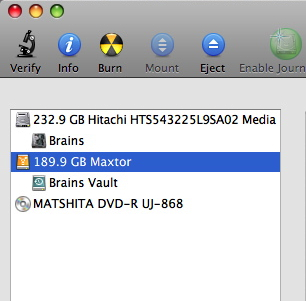
For example, in the screenshot here, the first drive listed (320.07 Hitachi) is the internal drive of my iMac. Listed underneath that is the one partition that’s on the internal drive called iMac. The second drive listed (1 TB CalDigit) is an external hard drive with a single partition called 1TB External. The last device listed is the internal optical drive.
There is a set of tabs across the top right part of Disk Utility. To partition a drive, the first step is to select the drive you want to partition in the left column and click on the Partition tab. The drive is selected in the left column, and I clicked on the Partition tab. No ribbon and toolbar under preferences word for mac. Disk Utility shows the current partition of the drive.
In the next step, we will define the Partition Layout so that two partitions will be created. There are a few ways to adjust the size of the partitions. In the graphic the represents the partitions, there’s a dot between the partitions.
Click and drag up or down to adjust the sizes. To see the actual capacity when you adjust the size, click on one of the partitions so that it has a blue outline. Then you’ll see the capacity in the Size box. You can also select a partition and enter the desired capacity in the Size box.
In this example, the first partition will be set to 300GB, while the second will be set to 700GB. Another way to set your partitions is to use the + and — buttons. These buttons are especially handy if you want to divide a specific partition into more partitions. For example, say you want to create three partitions, one 500GB, and the other two 250GB each. Selecting 3 Partitions in the Partition Layout menu creates three partitions of equal size.