
Advertisement Every Windows user should know the basics of working on a Mac. Here's a quick guide to help Mac newcomers find their way around. can be a shock for new users. Your favorite shortcuts from Windows don’t work, useful keys such as Home and End are missing from your Mac’s keyboard, and Apple’s ctrl key functions nothing like the one on Windows. But don’t despair! Your muscle memory just needs time to catch up with No matter what operating system or program you're using, keyboard shortcuts are a tool you can use to make things quite a bit easier for yourself. Simply not having to take your hands off the.
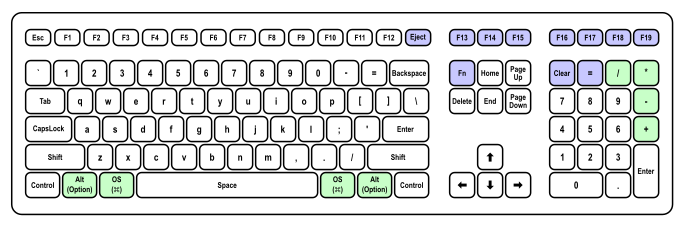
It’s a relatively short period of adjustment, and you’ll get there in no time if you remember a few simple differences between the two systems. So here’s a quick start guide to adjusting to a Mac keyboard layout. Notes: • Certain shortcuts may vary depending on the version of Windows and keyboard you’re using. • Only Mac keys and shortcuts are highlighted in bold print in this article. Control (Windows) = Command (OS X) The command or cmd key, which you’ll find on either side of the spacebar, is the Mac equivalent of the Control (ctrl) key on Windows. Many of your Windows shortcuts involving the ctrl key work on Mac as well if you use cmd instead of ctrl.
Instead, you can virtualize the Touch Bar software right on your Mac's desktop. To get started, you first need to make sure you are running the latest version of MacOS Sierra, version 10.12.1.
For example, the cut-copy-paste shortcuts from Windows — ctrl+x, ctrl+c, ctrl+v — turn into cmd+x, cmd+c, and cmd+v respectively on a Mac. Go ahead and try some of the other ctrl-based shortcuts from Windows using the cmd key, such as cmd+d instead of ctrl+d for bookmarking a web page. OS X also has a key named control (ctrl). You’ll find it sandwiched between the fn and option keys to the left of the spacebar. This ctrl key is part of a few keyboard shortcuts that you’ll discover as you continue to use your new Mac. For now, the main thing you need to know about the ctrl key is that you can combine it with a mouse click to open up the context menu, also known as the right-click menu, anywhere on your Mac. If you wish the ctrl key on your Mac would function like the ctrl key on your Windows machine, we recommend swapping the functions of the cmd and ctrl keys.
To do so, first click on the Apple icon at the top left in the menu bar and go to System Preferences > Keyboard. Alt+Tab (Windows) = Command+Tab (OS X) If you love the alt+tab combo on Windows for application switching, you won’t have too much trouble getting used to Mac’s application switcher keyboard shortcut — cmd+tab. That’s because the OS X cmd key happens to be in the same location as the Windows alt key — just to the left of the spacebar.  You won’t even need to memorize the shortcut.
Your muscle memory has already done it for you. Renaming Files With Enter on OS X What happens when you select a file and hit Enter on Windows? File Explorer opens the file in its default application.
Not so on a Mac. Hitting enter when you have a file (or folder) selected allows you to rename it — just like the F2 key does on Windows. To open the file using the keyboard, you’ll have to press cmd+o. By the way, tapping the spacebar when you have a file selected allows you to fully preview the file without having to open it up in its usual application.
You can download Anomaly 2 1.0 for Mac from our software library for free. This Mac download was scanned by our antivirus and was rated as malware free. The application lies within Games, more precisely Strategy. The actual developer of this Mac application is 11 bit studios s.a. Anomaly Defenders, Anomaly 2 & Anomaly: Warzone Earth torrent download for PC on this webpage, allready activated full repack Anomaly: Warzone Earth (2011): Blending fast-paced, explosive action with tactical battlefield command, Anomaly puts players in charge of a military. Anomaly 2 mac torrent.
Home/End (Windows) = Command+Arrow Keys (OS X) The Home and End keys on a PC keyboard are super useful, but they’re missing from many Mac keyboards. You won’t miss them once you get used to their keyboard shortcuts: cmd+left arrow for Home and cmd+right arrow for End. For this pair of shortcuts, use the cmd key to the right of the spacebar for convenience. Note that ctrl+a and ctrl+e also work as shortcuts for Home and End respectively — but when you’re working with text, this will take you to the end of the paragraph (as opposed to cmd+arrow key which takes you to the end of the line).